Wednesday, July 14, 2010

Highest Shellpot Creek has ever been.


Technically, with this flooding, my house is on an island in the middle of Shellpot Creek because the creek has overflowed its banks and is going down the road in front of the house as well as the turbulent mess behind the house.

This video is of the waterfall.

Phylogentic Trees and Language

Recent searches led me to several interesting articles by Mark Pagel and co-authors on the evolution of languages. These links may be behind Science or Nature paywalls or subscriptions, so I apologize if you are unable to read them.

The basic point is that:

1.) Researchers are using phylogenetic trees to classify the relatedness of languages and their divergence from earlier languages. This is an old idea. The link above is to a review of recent work using the justifying using these tools due to the genetic-like properties of language.

2.) The proposal is that languages evolve in punctuated bursts, not gradually. Perhaps because populations becames seperated physically, Perhaps because groups wanted to differentiate themselves culturally.


Languages Evolve in Punctuational Bursts by Quentin D. Atkinson, Andrew Meade, Chris Venditti, Simon J. Greenhill, Mark Pagel; Science, 1 February 2008: Vol. 319. no. 5863, p. 588, DOI: 10.1126/science.1149683

Human language as a culturally transmitted replicator by Mark Pagel, Nature Reviews Genetics 10, 405-415 (June 2009) | doi:10.1038/nrg2560

Tuesday, July 13, 2010

More video of the raging Shellpot Creek


Watch the large branch go under just above the waterfall at the beginning of the video. There were many large logs going by. Just as long as they keep going by and don't get stuck on my part of the creek.

Video of Raging Shellpot Creek


The creek is roaring today.

Shellpot Creek is a raging torrent this morning

Shellpot Creek is pretty full this morning after a long downpour with thunder and lightning. It has been dry so long and even the few rain breaks hadn't really filled the creek to the brim this summer yet. It is interesting to see it be wild like this Video to come.

Monday, July 12, 2010

I missed a solar eclipse on Easter Island

Apparently there was a total eclipse Sunday that was only visible across large swaths of the uninhabitated Spouth Pacific (yahoo coverage). It was visible for Chile, and Tahiti and Easter Island. I have been to Easter Island! Given how tiny that island is it is a surprise that an eclipse would catch it, though I suppose almost everywhere on the globe has them sometime.

With the baby and the expense and so many other places to travel to we wouldn't have gone back to see it, but a solar eclipse and Moai in the same shot would have been awesome.


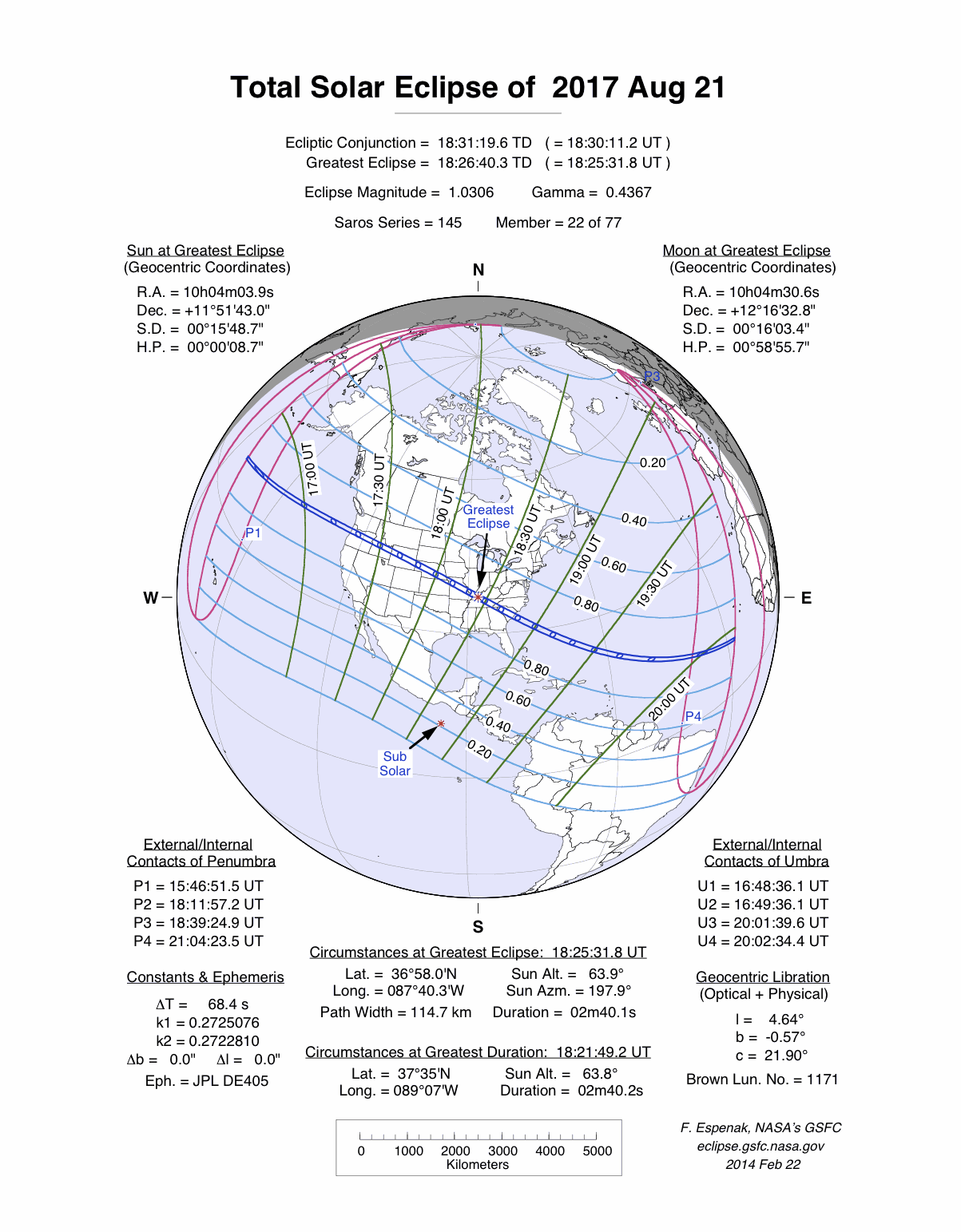
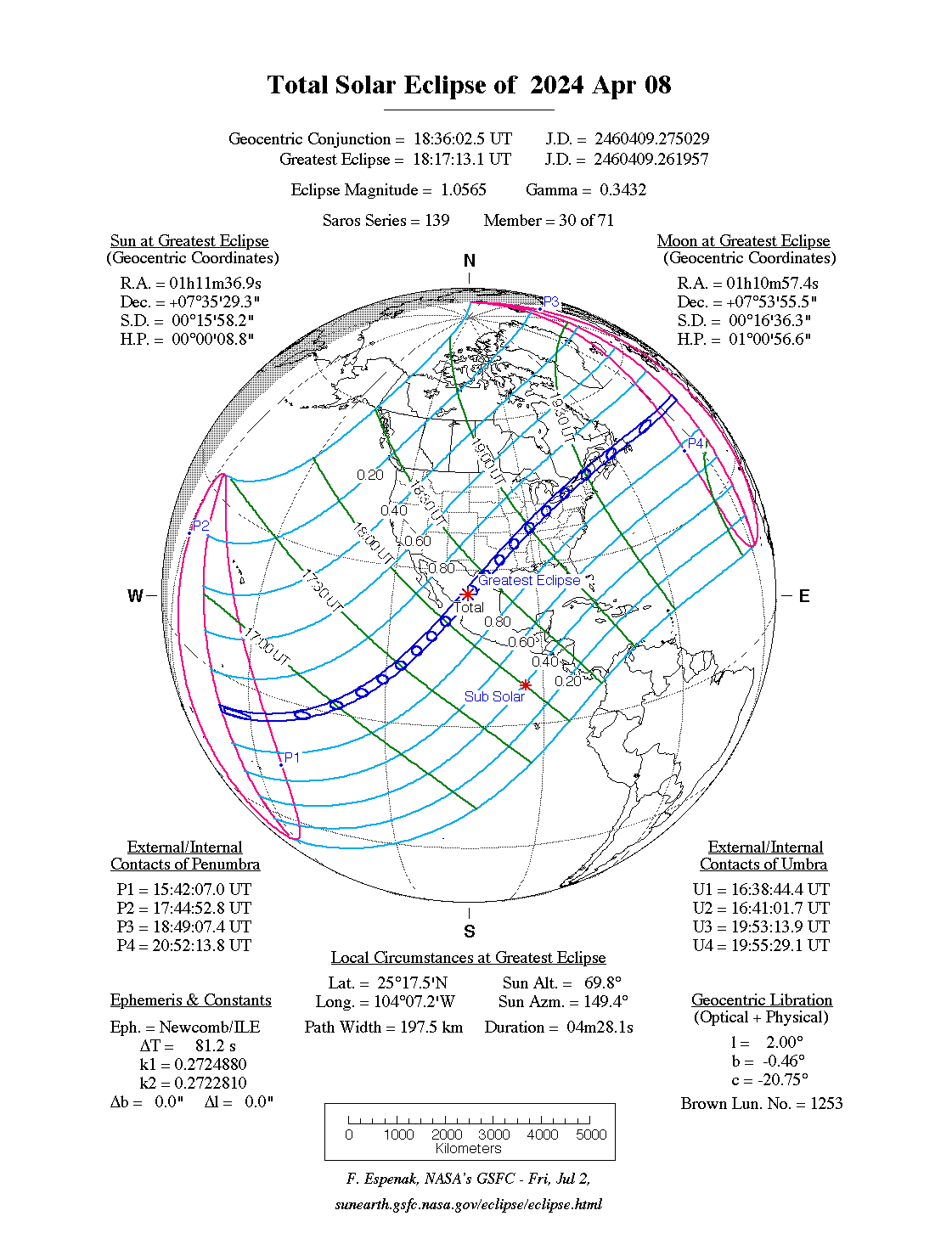
I am holding out for the United States eclipses of August 21st 2017, and April 8th 2024. They will be close together and there is a spot in Southern Illinois near Kentucky including Carbondale, Cape Girardeau, Missouri, and Paducah, Kentucky which will experience both solar eclipses, two in seven years.

Monster Truck on I95 in Delaware

Yesterday we were driving back home from Norristown down I476 to I95 when we spotted a unusually tall pickup truck in front of us.


It was a monster truck driving with us on the road.


It was driving next to us on I95 from Norristown to at least the Marsh road exit just south of the Delaware state line where we got off. This vehicle was just a little pickup truck on huge tires and a suspension to go with them. The tires and modifications made the vehicle literally twice as tall as our Prius.


We got a closeup of one of the tires.

Besides the silliness of seeing a monster truck on the road was the advertising on the side for Estep Electrical Services. You know the "owner" of the truck "uses" it for work and the expense of those crazy modifications were written off of their taxes.

Thursday, July 08, 2010

Psychological studies skewed by WEIRDness

At Carnegie Mellon I remember that a prerequisite for my psychology classes was to participate in a certain number of psychology experiments. We were the free subjects for the Carnegie Mellon Psychology department. Our department was not unique in this practice and Heinrich Joseph, Stephen Heine, and Ara Norenzayan from the University of British Columbia have a review paper in Behavioral and Brain Science says that the overwhelming number of psychology studies in the literature use undergraduates from the United States and Europe in their studies. The problem with that is that these undergraduates are unique in the world, typically being, Western, educated, industrialized, rich and democratic and that these WEIRDos are not representative of humanity as a whole.

The typical example of test that yields startling different results for the US and Europe vs. other countries on the world is the classic Müller-Lyer illusion where the test subject must decide which of the lines is longer, Americans and Europeans typically think that the line with the arrows pointing out is shorter, but this is not a typical answer around the world. The chart below shows the increased length of the "short" line required to make the lines seem similar. People in industrialized nations (to the right on the chart below) show the most effect.


The review paper discusses a wide range of psychology experiments designed to explore the free-rider problem and punishment from economics, through language development and family based reasoning (clumped by function - notebook-pencil) vs. rule based reasoning (notebook-magazine), to other social psychology problems.

The authors conclusions include that generalizing experimental results from WEIRD test subjects to the world population as a whole may yield very incorrect generalizations.


In the open peer commentary to the paper (found at the end of the paper at this .pdf link), other psychology researchers propose other reasons and commentary for and on the presumed outlier nature of WEIRD subjects in psychology experiments vs. the rest of the world. Some highlights are briefly listed below.

  • One group proposes that the experiments are weird, not the subjects.

  • Another suggests the variations within populations are not taken into account correctly.

  • Some argue that brain scientists are just as guilty as psychologists in using WEIRD subjects, and that generalizing results from a narrow sample of WEIRD brain subjects to the entire species is also unwise.

  • Many provide suggestions in reaching a wider sample pool. Although the one suggestion to use the Internet will then select for a worldwide population with access to the Internet - that may also be an unusual population The authors address this in their response to the commentary.

  • Others caution against generalization in animal studies and coin their own acronymical description of chimpanzees in animal experiments: Barren, Institutional, Zoo, And other Rare Rearing Environments (BIZARRE) chimpanzees. This is only one of several acronyms coined in the commentary (WRONG - When Researchers Overlook uNderlying Genotypes, ODD - Observation- and Description-Deprived psychological research)

  • Some point out that it is not just the subjects, but there are also too many WEIRD researchers.

  • One points out that the WEIRD subjects are a harbinger of what the world is becoming and wants more research on all of the variations in human experience before we become culturally homogenized. One of the more hopeful comments I thought, though it implies a trade-off between prosperity and diversity.
I suggest that you read the review and the back and forth commentary if this peaks your interest. The take home lesson appears to be that you need to be aware of the selection of your sample subjects in social, psychological and cultural experiments, using caution when reasoning from a narrow sample to the larger population (or species) and do not assume that everyone (in the world, in your culture, in the same room as you) are all the same, except when they are.

Monday, July 05, 2010

Modeling soccer (and perhaps your work team) as a social network

Frequent readers will be aware that an occasional hobby of mine is to numerically model sports and other interesting activities yet I lack much of the time or tools to do so. I have taken on NFL playoff football, both the entire playoffs and detailed modeling of the Superbowl down to the player level. I have also attempted, unsuccessfully, to model March Madness, the NCAA basketball playoffs, performing mostly analysis as opposed building a model that helps me win a March madness pool. Thus, I love to read interesting modeling papers, especially those which model sports or games as models for other real world activities.

The contributions of individual players in sports like football, baseball and basketball are helped by the large amount to statistics collected and available for these sports. Thus the contribution for individual team members to the team success is easier to model. Science online has a report of some work done by Jordi Duch and other researchers, at Northwestern and in Spain, that attempts to model the contributions of soccer players to the success of their team.

They point out that soccer is a very fluid game compared to baseball, or football and that combined with the very low scores makes statistics like goals and assists insufficient to model the contribution of players to the performance of the team. They hypothesize that the passes and flow of the game leading up to the rare goals are important for determining the outcome of the game and they use networks to model this flow. Players are nodes in the network and the lines between the nodes, called arcs, represent passes. Much as a Facebook or Twitter can be modeled as a network with friendship and interactions or follower/following being the connections, soccer is a "social" sport.

They also include nodes for the goal and for shots wide of the goal. To each of these arcs the attach statistics and probabilities from the 2008 European football championship on play pass accuracy, and goal accuracy to the arcs. One could them follow the ball through this "ball flow" network to a goal, a miss or to the other team. Combined with more calculations the group attempts to predict the outcome of soccer games.

Even more interestingly, the authors apply this concept to a work team that is writing a paper with several co-authors. Instead of the nodes being soccer players in paper network, a node represents a co-author in the manuscript, and the lines between the nodes represent communications directed from one co-author to the others. The e-mails represent communications between coauthors and the effectiveness of the authors is measured by completion of tasks like performing a calculation or scheduling a meeting. In the diagram below, author A2 (I think A3 in the second chart is a typos) seems to be an important and strong contributor.

One of the authors, comments on how the scheme can be used to assess the contribution of individual team members.
"One of the issues with any kind of teamwork is assigning the right credit," says Amaral. "The wild, loud people get more credit, but with this analysis you can get a picture of how much an individual really contributes to an outcome."
As work continues to evolve to be more team driven and highly networked, perhaps a scheme like this can not only point out strong contributors to a team, but also help an entire team work at a higher level. Imagine it applied to the work of developing open source software or Wikipedia articles.

(via Science online, the paper at Public Library of Science, PLoS, figures above are from the paper can be found at this .pdf link)

Thursday, July 01, 2010

Fireworks from Greenville Country Club


Good friends of ours live behind Greenville Country Club in Greenville, Delaware. Each year they invite us to watch the country club's fireworks from the comfort of their backyard meadow. This year's fireworks were on July 1st, tonight. As always I tried to get some pictures.