Tuesday, March 27, 2007

Elemental my dear.

One of my favorite webcomics is Order of the Stick. Rich Burlew combines D&D style role-playing and fun with some observations of the world into quite a few clever comics. Sometimes the strips have many fun points, not just one. As a chemical engineer I really appreciated a recent strip in which he has the bad guys create Elementals to storm the good guy's castle walls in a siege.


These are not your scientifically inaccurate fire, air, water and earth elementals, his characters have taken and passed chemistry, so these are periodic table of the elements elementals. These titanium elementals even have the properties of titanium that makes it so good for golf clubs and rocket ships, light but strong.

Dungeons and Dragons updated to at least the 19th century. Mendeleev would be proud (I recommend Mendeleyev's Dream by Paul Strathen to hear the interesting story of the periodic table). Does this mean there are now 118 or so elemental planes instead of the four from the original Dungeons and Dragons game? Can you imagine a chlorine elemental or plutonium elemental being sent after your player character during a rousing session of Dungeons and Dragons? Neutralize the first with water and the second with graphite rods I guess.

Presenting the new radiation warning symbol

The International Atomic Energy Agency spent $200,000 to develop a new radiation warning symbol because they found that people do not know what the yellow trefoil stands for anymore. The development of the symbol took five years and was tested on 1650 people in 11 countries. It seems like a good design, everyone knows that a skull and crossbones means death or pirates and if something is emitting squiggly beams that cause death or pirates you should run away.

The symbol is intended to supplement the current symbol and is "to be placed on the device housing the source, as a warning not to dismantle the device or to get any closer. It will not be visible under normal use, only if someone attempts to disassemble the device. The symbol will not be located on building access doors, transportation packages or containers." The new symbol is also intended to highlight the dangers of large sources of ionizing radiation especially.

Think of the symbols this way. The yellow one goes on your smelly sock drawer to warn people of the danger inside. The red symbol goes inside the smelly sock drawer on top of the socks to warn someone of the immanent danger of coming in contact with radioactive (smelly) socks and to get away. This yields two levels of warning. Now that there are two, I wonder which one will become the new symbol of evil after the Apocalypse.

(Get your symbol in .pdf format here)

(via Science and the IAEA)

Is Wikipedia dangerous to the conspiracy theory addled mind?

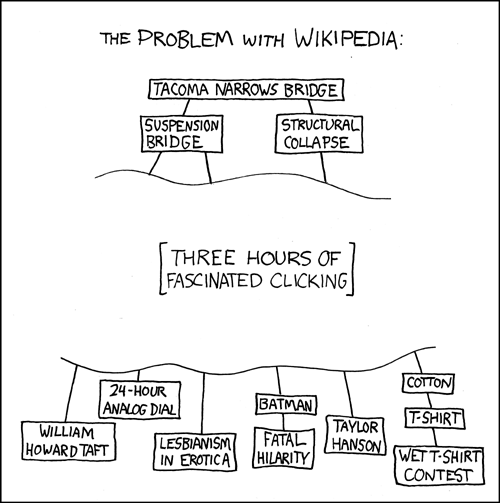
xkcd points out that Wikipedia can be quite a time waster as you click from interesting topic to topic when you get distracted in your search for a bit of useful information.

I used to try to do this with regular encyclopedias (on paper no less), but it is so much easier using hyperlinks on the web. Tabbed browsing doesn't suppress this behavior, it only enhances it. My particular chain took an interesting conspiracy theory/ free mason/ alternate religion path.

I started with the Infamous things that have happened on Saturday Night Live linked to from from a reddit post about the people banned from appearing on SNL, there is quite a list.

That led to looking up what 30 Rock is, because I like that TV show. In this reference though, 30 rock is a nickname for the GE building, from its address, 30 Rockefeller Plaza.

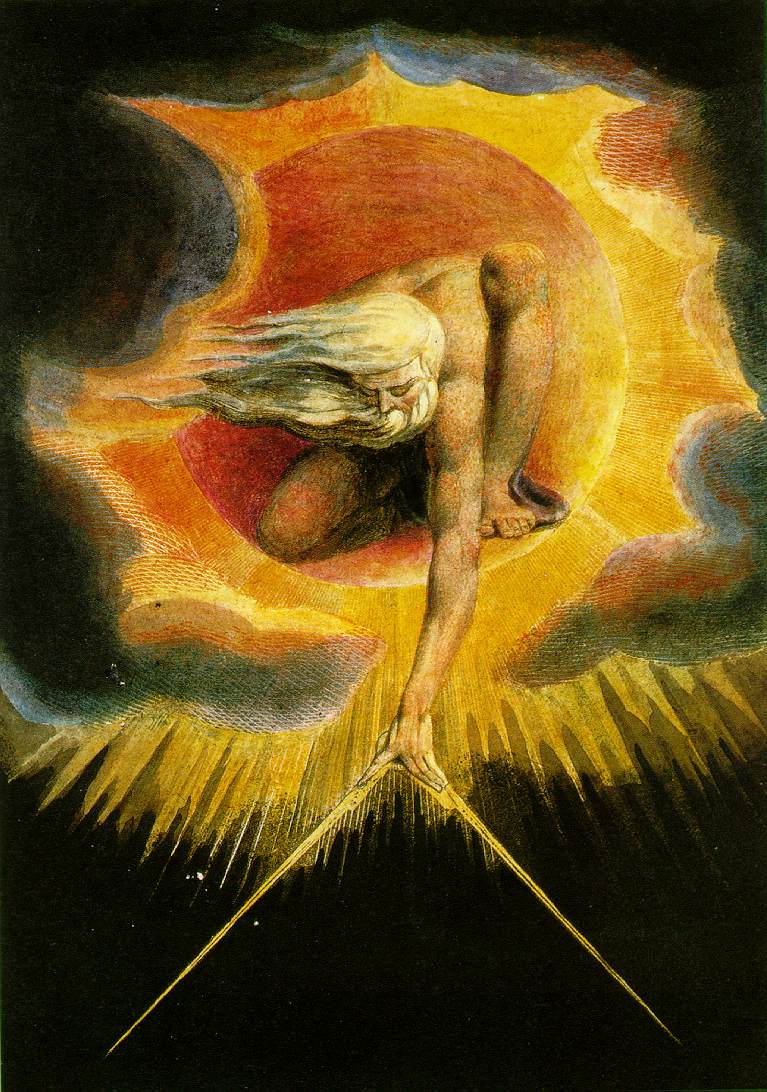
The GE building is a pretty famous landmark in New York and has a sculpture in front that is evocative of William Blake's Ancient of Days.

It turns out that Ancient of Days is another name for God but that different traditions have different meanings. This was my chance to look at all the names for God, but instead I jumped to Esotericism because it sounded interesting and that group has a different interpretation on Ancient of Days.

Esotericism, as Wikipedia reports it, largely overlaps with "hidden knowledge." There was some mention of the ancient mystery religions and a claim that Christianity was one of them and interesting comments about Gnosticism about Hermeticism.

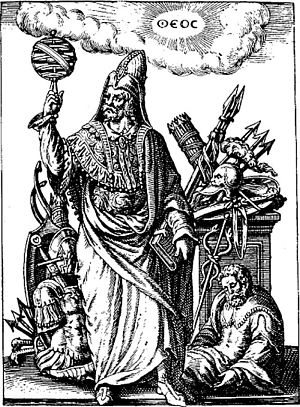
Gnosticism and its hidden knowledge aspect seemed to be too easy a choice so I took the Hermeticism branch instead and fell right into a discussion of Hermes Trismegistus who may or may not have existed but is suggested as the founder of a whole system of beliefs of which The Order of Freemasons and Rosicrucianism are based.

Let's stop here.

My theory is that Wikipedia and the Internet it is a part of are either schizophrenic themselves or are conducive to schizophrenia. My innocent clicking of links led me deeper into an alternate world of secret religions and hidden knowledge and farther from rational discourse and reality. I am lucky that I don't hear voices in my head right now. Maybe the real secret is that there is a conspiracy to make people believe in conspiracy theories and secret societies all of which may or may not exist. I call it the meta-conspiracy theory.


Saturday, March 24, 2007

Don't get rooked into this one.

In the chess game of life which piece are you?
A Black Bishop
You scored 2 Power-Finesse, 4 Leader-Follower, 3 Unique-Ordinary, and 1 Offense-Defense!

You are conniving and sneaky, and often overlooked by your opponent. You are content to stay off to one side, allowing the bloodbath to ensue. Then, when the moment is right and the other king has let his guard down you strike! Your indirect approach to things gives your team more options. However, in the big picture you are expendable. No matter how hard you try, you can only reach half the squares on the board.


(via Exploding Aardvark)

I scream, you scream, we all scream for a reinstated Ice Cream Festival.

New Castle County is cancelling the Ice Cream Festival! This festival is probably one of the most famous and popular events to happen at Rockwood park in Wilmington. Started as a fundraising event for the mansion it was taken over by the Park system. That takeover was controversial in and of itself but now the budget problems have killed the event completely.

The article says the changes to the event calendar will save the county $341,000 but they are facing a deficit growing to $49 million in 2009. These two numbers bear no relation to each other. You only need 143 more opportunities like cancelling the ice cream festival to close the gap on the deficit. Perhaps we should be focusing on the larger ticket items. I have tried to interpret the New Castle budget, I invite you to do so yourself. They estimate they will take in $328 million this year. Perhaps they could find some way to restore the Festival.


No more Ice Cream Festival, no more fireworks?

The three comment threads (1, 2, 3) following the various articles (Cancelled events and frozen paychecks, Cancelled Ice Cream Festival, 17% tax hike) mentioning the budget and cancellation are overwhelmingly against cancellation and disgusted with County government.

For instance: -
"It becomes more clear every day that the citizens in New Castle County need to cancel the employment of the current County Executive, County Council President and the Council Person..."
I like this explanation -
"maybe he is lactose intolerant..."
Or maybe a comment on past excesses:
"Anyone remember how Tom Gordon gave away $15 million to the City of Wilmington? I think we need to put the blame where it really is...the lavish spending of Coons' predecessor. "
I remember. The county remembers. How pathetic is it when the county is now asking the City of Wilmington for money. Those two governments seem to now be in a race to be the worst managed.

I have pointed out that the citizens of the county continue to elect the same corrupt or incompetent officials to County office. Coons was around when Gordon and Freeberry pulled their stunts and now he has demonstrated that he cannot run the County.

Hey Delawareans, doesn't this upset you?

tags: , , , , , ,

Sunday, March 18, 2007

Can't get enough statistical analysis of March Madness upset picks

I decided to go back through the data I have accumulated from NCAA tournaments from 1985 to 2005 in order to see just how many points one could achieve by picking the winners with 100% accuracy. The point total scheme to be used is based on the sum of the seeds multiplied by a Round factor:

points = sum of winning seeds of 1st round * 1
+ sum of winning seeds of 2nd round * 2
+ sum of winning seeds of Sweet 16 Round * 4
+ sum of winning seeds of Elite 8 Round * 8
+ sum of winning seeds of Final Four Round * 16
+seed of the Champion * 32

As mentioned in earlier analyses this scheme encourages picking upsets since you get correspondingly more points. The big problem remains: which upsets to pick, and did I pick the right number of upsets. The following chart shows 21 year of data and the point totals expected for each. (click to enlarge)

This chart lets us answer some questions about which round is the most important for points and whether the tournament is the same from year to year or very different. Most years have around 185 points for Round 1, and 150 points for Round 2 and have the variability in the number of points increasing in later Rounds.

The highest point total year was 1985 (909 points) when #8 seed Villanova won the entire tournament and the #8 factor multiplied through every round. 1988 (799 points) had #6 seed Kansas win the entire tournament with similar effect. Lowest point year 1993 (only 486 points) had the opposite effect with almost no upsets the entire tournament and 3 #1 seeds and a #2 seed in the Final Four.

The point totals are high in 2000 for a different reason. In 2000 (789 points) two #8 seeds, North Carolina and Wisconsin made it to the Final Four. It is apparent and maybe obvious that years with upsets have correspondingly higher potential for points based on the upset scoring format, but that these points show up more in later rounds than in Rounds 1 and 2.

The next chart shows the distribution of the points for the past 21 years. (Click to enlarge) Half of the totals are less than 632 and 90% are less than 789. After the bracket is together for a particular year you can calculate the potential points assuming that all of the picks are right. It seems to me that this potential point total should reflect the distribution of past tournaments.

Thus, potential point totals of 600 to 650 reflect the most common potential point totals from the past. If you have chosen a bracket that falls out side of the ranges above they are statistically less likely. This type of analysis should allow you to check a bracket once it is complete to ensure that you haven't chosen too wildly or too conservatively. My potential point total this year was around 450, so I now feel that that was too conservative.

The next analysis needs to get at the difficult point of exactly which upsets to pick and how to perform the above analysis taking into account that no one gets all of the picks correctly. What is the correct way to make picks that ensures I get the bounce in the points in later rounds?

Saturday, March 17, 2007

Happy St. Patrick's Day

It's just not a holiday without a T-shirt to celebrate.

Today I recommend reading "How the Irish Saved Civilization" by Thomas Cahill. I am also having corned beef and cabbage with my Guinness.

Friday, March 16, 2007

Three rules for eating

In recent post, the Virtual Ranger describes a dinner party with some invertebrate entrees. I strongly suggest caution when reading the Ranger's post as he is eating BUGS!

The ranger has failed to follow the three important rules for eating (my mother taught me this):

1.) Never eat anything that is still alive. The bugs eaten by the Ranger fall into this category from sheer force of imagination. Most Klingon food falls into this catagory.

2.) Never eat anything that looks like it has already been eaten. A good example would be refried beans. I never felt the need to expand this category to include things that had actually been eaten but having heard of weasel coffee (Civets eat and poop out the coffee beans which are then roasted and brewed) I now must add a corollary to this rule.

3.) Never eat anything that looks back at you. This covers fish with the heads on. The plate always seems to be placed so that the eyes point at me. This could even cover sunny side up eggs if they are arranged properly. Sometimes the eggs try to stare you down.

Wednesday, March 14, 2007

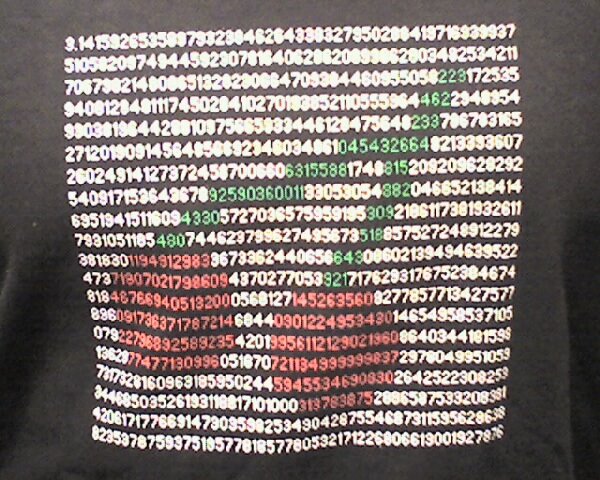
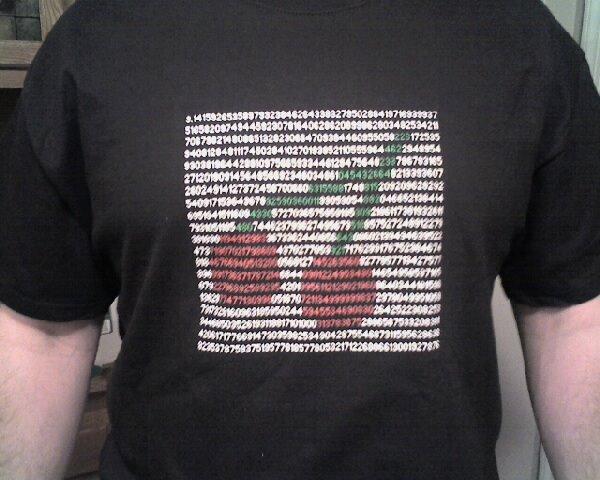
The Pi shirt has arrived for Pi day!

I thought I wouldn't get it in time.

Some last March Madness NCAA Basketball pool advice.

The NCAA Basketball March Madness pool that I play in encourages upset picks by weighting the points by the seed in the tournament. You get the seed for the win. If #13 Davidson beats #4 Maryland you get 13 points, otherwise you get 4 points. Each round is multiplied by a factor, first round is 1, second is 2, third is 4 and so on to 32 points multiplied by the seed of the overall winner. It is ingenious because being safe doesn't translate into as many points as picking upsets, and that's the key to winning the whole thing.

Last year I did some extensive upset probability analysis of upsets in the round of 64 and round of 32. I also separately analyzed the final four and the winner. This year I am spending my time on my picks so I will just use the analysis from last year, which does neglect the 2006 results, but that is a small effect over the 21 years of data already in the analysis.

My advice:
  • Pick the #1 team in the first round. They have never lost, and you are not going to be the lucky one who finally picks it when they do.
  • For almost the same reason as above, pick the #2 team to win in the first round also.


  • Pick upsets in the first round for the other matchups. #8 vs. #9 seeds are worse than toss ups, more than half of the time the #9 seed wins. Even #12 beats #5 one in three times.
  • Pick more upsets in the second round. Almost half the time, 12 beat 4, 5 beat 4, 6 beat 3, 10 beat 2. A quarter of the time 8 beat 1, 7 beat 2, and 11 beat 4. Some of those matchups are rare, so take the statistics with a grain of salt.


  • The worst seed to win the tournament was #8 and this happened only once. The worst seed to make it to the Final Four was ranked #11, which also only happened once. Since these are highly improbably events your bracket should avoid them.

  • Get some more information about the individual teams, but don't rely too heavily on it (see upsets above). I am using the Sagarin ratings for some extra information on where teams were ranked over the year and as a substitute for my utter lack of knowledge about college basketball. This gives me some way to guess where the upsets that are expected above will happen. My excitement is in the math more than the sport.

Finally, on any given day any team can beat any other team. The key to winning is picking which upsets will happen and that takes some knowledge of the teams. Good luck.

tags: , , ,